Root Growth, Thatch, and the Math Nobody's Talking About
Everybody in this industry talks about "faster." Faster green-up, faster root growth, faster thatch breakdown. Almost nobody talks about what's actually happening underneath those claims — the biology that drives root growth, the chemistry of what thatch actually is, and the nitrogen cost of getting rid of it. Let's talk about all three.
Fine Particles Aren't the Same as Finished Decomposition
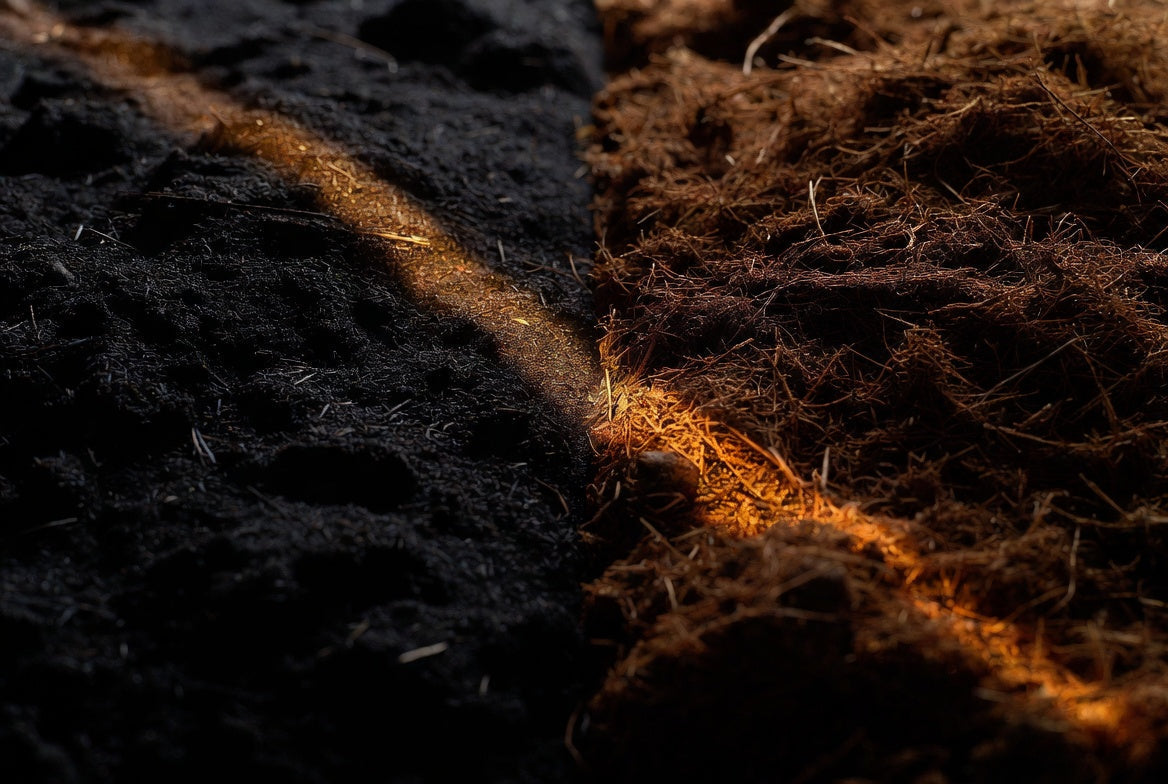
A lot of engineered composts are marketed on how finely they're screened — "greens grade," 1/8 inch, sifted smooth. Fine screening is a physical property. It tells you the particle size. It tells you nothing about how decomposed the material actually is.
Compost, no matter how finely it's sifted or how aggressively it's marketed, is still compost — organic material at some stage of breaking down. Sifting it fine doesn't finish the decomposition process; it just makes the unfinished material smaller. (For the full breakdown of organic matter versus organic debris, see our resource on the topic — it's the foundation for everything below.)
What Actually Drives Root Growth
Faster establishment and root development aren't magic. They come down to specific biological mechanisms — and DAKOTA Peat and REV Turf Pro have them natively, verified independently, no lab excuse required:
- Auxin (IAA) production — the plant hormone that drives root elongation and cell division. DAKOTA's native microbiome shows 42% of species capable of producing it.
- ACC deaminase — reduces ethylene stress in plants, directly tied to stress tolerance and root development under pressure. 46% of DAKOTA's microbial species carry this capability.
- Carbon fixation — the foundation of long-term soil fertility. 69% of DAKOTA's microbiome is actively building stable soil carbon.
These numbers come from independent BECROP DNA sequencing, not a marketing sheet. (Full data here.) Root growth doesn't require an engineered inoculant when the native biology already does the work.
Where Thatch Actually Comes From
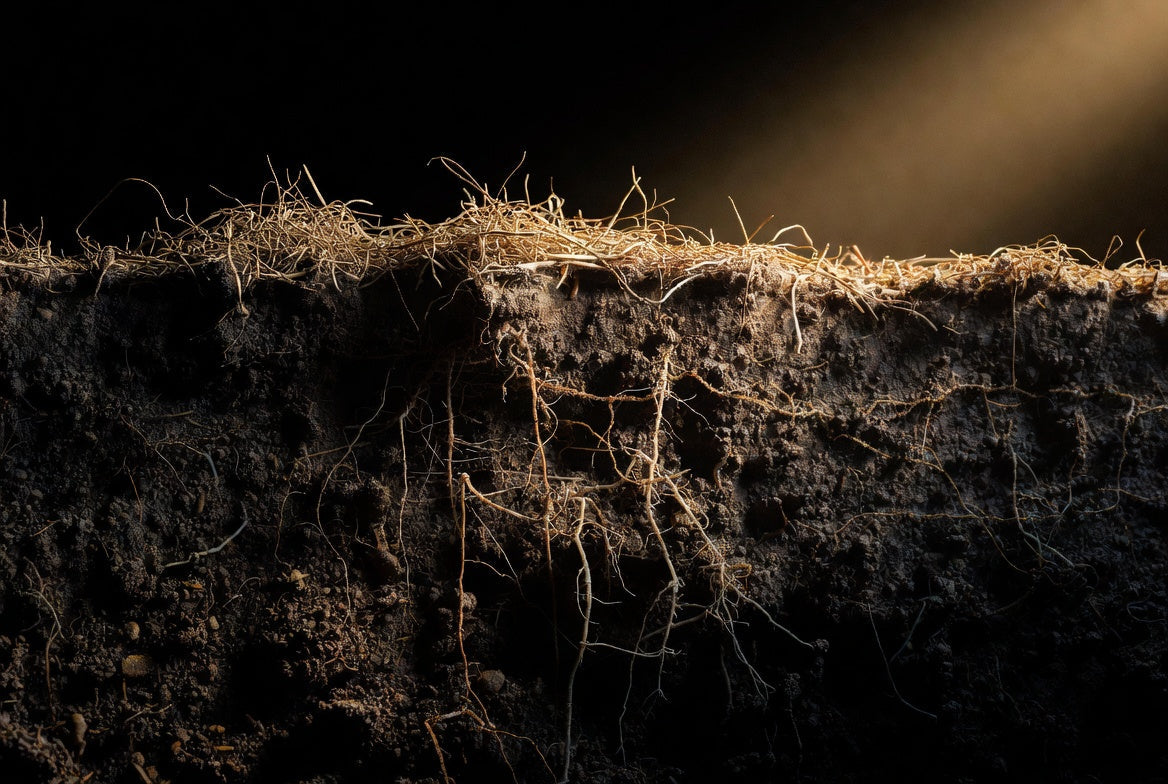
Turf is constantly regenerating itself. Roots, stems, and leaf tissue are always dying off as the plant grows — and that dead organic material doesn't just disappear. It accumulates at the surface, above the soil, as a layer of largely undecomposed organic debris. That layer is thatch.
Here's something worth knowing: even COMAND's own product literature draws this exact distinction — describing thatch as organic material that's largely undecomposed, while positioning their own product as organic matter that's already decomposed and stabilized. We agree with that framework completely. We just think it's worth applying consistently — including to the product doing the explaining.
The Nitrogen Math
Here's the part that rarely gets mentioned: breaking down organic material costs nitrogen. When soil microbes decompose carbon-rich debris, they need nitrogen to build their own biomass — so during active decomposition, some of the nitrogen that would otherwise feed your turf gets temporarily tied up instead. This isn't a claim about any specific product. It's basic soil chemistry, true of any decomposition process, and it matters more the less mature the material doing the decomposing actually is.
Any thatch-management approach built on active decomposition is, to some degree, borrowing nitrogen from your turf to pay for the process.
Why We Topdress DAKOTA Over Thatch
Here's our approach, and we know it sounds backwards the first time someone hears it: we recommend topdressing DAKOTA directly over the thatch layer. Laying organic matter on top of organic debris.
It works because DAKOTA isn't actively decomposing when it arrives — it's already stable, humic-rich material with a native, functioning microbiome. Instead of taxing your nitrogen budget to break itself down, DAKOTA's biology and humics get to work breaking down the debris layer beneath it, converting thatch into usable organic matter and pushing fertility back down to the roots — without the same nitrogen drawdown that active decomposition requires.
REV Turf Pro: The Thatch Eating Monster
If DAKOTA topdressing is the steady, reliable approach, REV Turf Pro is the aggressive one. Its ability to penetrate the thatch layer — not just sit on top of it — means it's delivering organic matter, humics, and microbials at every depth of the debris layer at once, working through thatch fast and pushing nutrients back to the roots as it goes. We've started calling it the Thatch Eating Monster internally, and honestly, the name fits.
The Practical Payoff: Rethinking Wetting Agents
Here's where this becomes a budget conversation, not just a science one. DAKOTA's hydrophilic behavior — it resists going hydrophobic the way sand-based rootzones and some organic amendments can — means many DAKOTA programs find they can significantly reduce, and in some cases eliminate, their dependence on synthetic wetting agents. Wetting agent programs commonly run $250 or more per month. A typical program pairing REV Turf Pro (roughly $50) with DAKOTA topdressing (roughly $200) can replace that spend with compounding, long-term benefits — better structure, better biology, better nitrogen efficiency — instead of a product that does one job and needs reapplying.
Every program is different, and your mileage will depend on your rootzone, climate, and current wetting agent use — but it's worth running the math on your own program.
Have questions about how this applies to your course or facility? Reach out to Robin@DAKOTApeat.com — we're happy to walk through the specifics with you.